Pose Graph Optimization


Correcting Odometry Drift with Loop Closures


Instructor: Hasan A. Poonawala

Mechanical and Aerospace Engineering
University of Kentucky, Lexington, KY, USA

Topics:
Odometry Drift Problem
Graph Structure
Nonlinear Least Squares Formulation

Lesson Overview

  1. Problem: Odometry drift accumulates over time
  2. Solution: Add loop closure constraints and optimize
  3. Formulation: Pose graph as nonlinear least squares
  4. Implementation: Gauss-Newton on sparse graphs

Paper: LOAM

Paper: Fast-LIO2

https://www.youtube.com/watch?v=uVcBa6NXAbk

Part 1: The Drift Problem

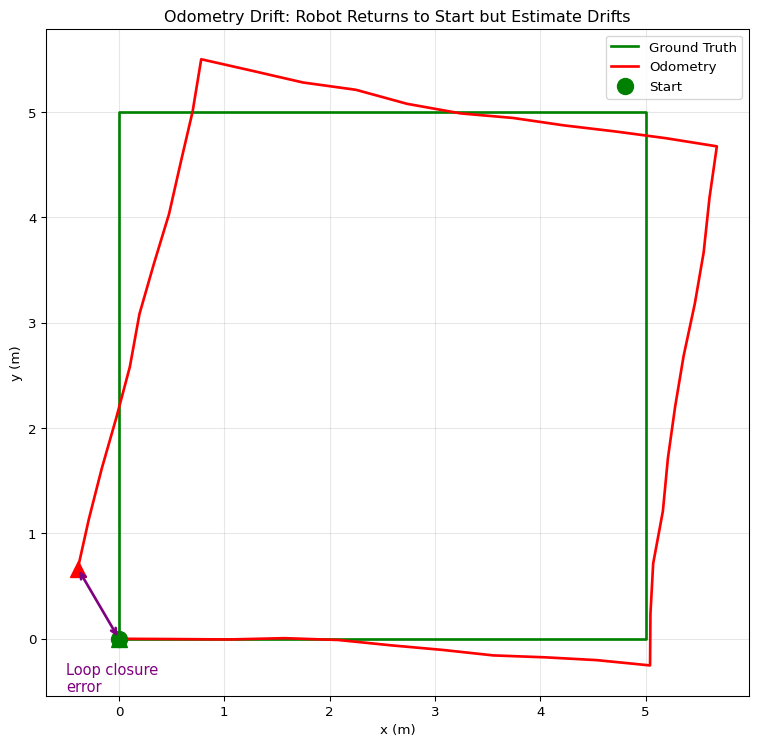
Recall: Odometry Drift

From scan matching or wheel odometry, we chain relative poses:

\[ T_{B_{k+1}}^{W} = T_{B_k}^{W} \cdot T_{B_{k+1}}^{B_k} \]

Each relative measurement \(T_{B_{k+1}}^{B_k}\) has small errors that accumulate.

Drift Visualization


Loop Closure

When the robot revisits a location, we can detect this by matching scans.

This gives us a constraint between non-sequential poses!

Loop Closure

A loop closure is a measurement that relates poses far apart in time but close in space.

What Loop Closure Tells Us

If scan matching at time \(k\) finds a good match with the scan from time \(j\) (where \(j \ll k\)):

We obtain an estimate of \(T_{B_k}^{B_j}\) — the relative pose between poses \(j\) and \(k\).

Problem: This measurement contradicts our odometry chain!

  • Odometry says: \(T_{B_k}^{B_j} = T_{B_{j+1}}^{B_j} \cdot T_{B_{j+2}}^{B_{j+1}} \cdots T_{B_k}^{B_{k-1}}\)
  • Loop closure says: \(T_{B_k}^{B_j} \approx \tilde{T}_{B_k}^{B_j}\) (from scan matching)

The Optimization Problem

We want to find poses that best satisfy all constraints:

  • Sequential constraints from odometry
  • Loop closure constraints from scan matching

This is a nonlinear least squares problem!

Part 2: Graph Structure

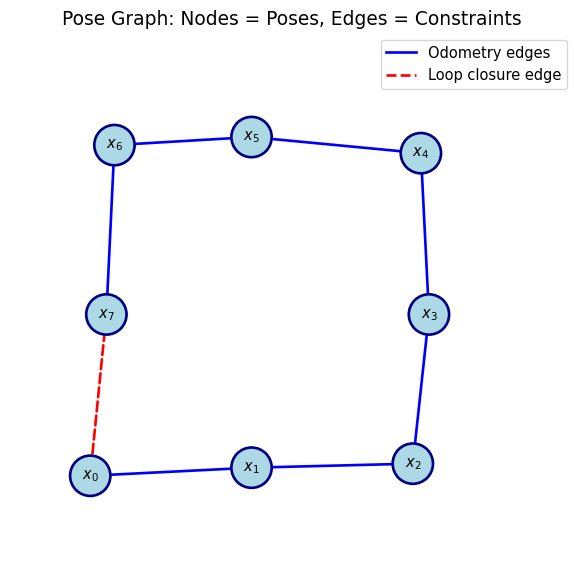
Pose Graph Representation

Graph Components

Nodes \(\mathcal{V} = \{x_0, x_1, \ldots, x_n\}\)

  • Each node is a robot pose: \(x_i = (x_i, y_i, \theta_i) \in SE(2)\)

Edges \(\mathcal{E} = \{(i, j)\}\)

  • Each edge represents a relative pose measurement \(\tilde{T}_{ij}\)
  • Sequential edges: \((0,1), (1,2), \ldots\) from odometry
  • Loop closure edges: \((j, k)\) where \(k \gg j\), from scan matching

Edge Measurement

An edge \((i, j)\) stores:

  1. Measured relative pose: \(\tilde{T}_{ij} = (\tilde{t}_x, \tilde{t}_y, \tilde{\theta})\)
    • “Pose \(j\) as seen from pose \(i\)
  1. Information matrix (optional): \(\Omega_{ij}\)
    • Encodes measurement confidence
    • More confident measurements have larger weight

Part 3: Least Squares Formulation

Residual for an Edge

Given estimated poses \(x_i = (x_i, y_i, \theta_i)\) and \(x_j = (x_j, y_j, \theta_j)\):

Predicted relative pose: \[ \hat{T}_{ij} = T_i^{-1} \circ T_j \]

Residual: Difference between predicted and measured \[ e_{ij} = \hat{T}_{ij} \ominus \tilde{T}_{ij} \]

SE(2) Residual Computation

In 2D, the residual has three components:

def pose_to_matrix(x, y, theta):
    """Convert pose (x, y, theta) to SE(2) matrix."""
    c, s = np.cos(theta), np.sin(theta)
    return np.array([[c, -s, x], [s, c, y], [0, 0, 1]])

def matrix_to_pose(T):
    """Extract (x, y, theta) from SE(2) matrix."""
    return T[0, 2], T[1, 2], np.arctan2(T[1, 0], T[0, 0])

def compute_residual(xi, xj, z_ij):
    """
    Compute residual for edge (i, j).
    xi, xj: poses (x, y, theta)
    z_ij: measured relative pose (dx, dy, dtheta)
    Returns: residual vector [ex, ey, etheta]

    Residual: e = [R_i^T @ (p_j - p_i); theta_j - theta_i] - z_ij
    """
    x_i, y_i, theta_i = xi[0], xi[1], xi[2]
    x_j, y_j, theta_j = xj[0], xj[1], xj[2]
    dx_meas, dy_meas, dtheta_meas = z_ij[0], z_ij[1], z_ij[2]

    c, s = np.cos(theta_i), np.sin(theta_i)

    # Predicted relative position (j in frame i)
    dx_world = x_j - x_i
    dy_world = y_j - y_i
    dx_pred = c * dx_world + s * dy_world
    dy_pred = -s * dx_world + c * dy_world
    dtheta_pred = theta_j - theta_i

    # Residual = predicted - measured
    e = np.array([
        dx_pred - dx_meas,
        dy_pred - dy_meas,
        np.arctan2(np.sin(dtheta_pred - dtheta_meas),
                   np.cos(dtheta_pred - dtheta_meas))  # Wrap angle
    ])
    return e

Cost Function

The total cost is the sum of squared residuals over all edges:

\[ F(x) = \sum_{(i,j) \in \mathcal{E}} e_{ij}^T \Omega_{ij} \, e_{ij} \]

where:

  • \(e_{ij} \in \mathbb{R}^3\) is the residual for edge \((i, j)\)
  • \(\Omega_{ij} \in \mathbb{R}^{3 \times 3}\) is the information matrix (often \(I_3\))

Note

This is exactly the nonlinear least squares problem from earlier lectures!

Jacobian Structure

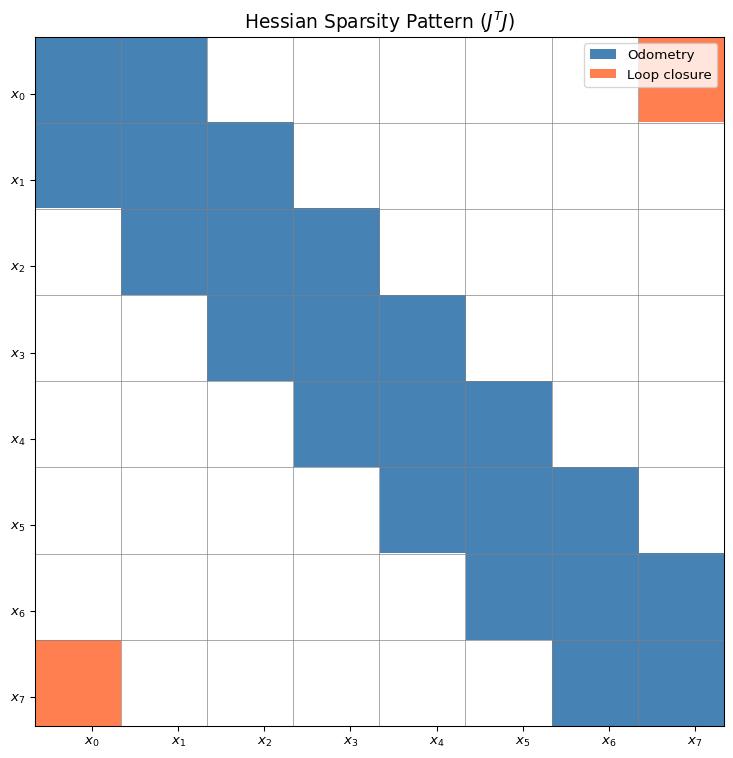
The residual \(e_{ij}\) depends only on poses \(x_i\) and \(x_j\).

Jacobians: \[ A_{ij} = \frac{\partial e_{ij}}{\partial x_i} \in \mathbb{R}^{3 \times 3}, \quad B_{ij} = \frac{\partial e_{ij}}{\partial x_j} \in \mathbb{R}^{3 \times 3} \]

The full Jacobian \(J\) is sparse: most entries are zero!

Sparsity Pattern

Tip

Sparsity is what makes large-scale SLAM tractable!

Jacobian for SE(2) Edge

For residual \(e_{ij}\) with poses \(x_i\) and \(x_j\):

def compute_jacobians(xi, xj, z_ij):
    """
    Compute Jacobians of residual w.r.t. poses xi and xj.
    Returns: A (de/dxi), B (de/dxj), both 3x3
    """
    theta_i = xi[2]
    c, s = np.cos(theta_i), np.sin(theta_i)
    dx = xj[0] - xi[0]
    dy = xj[1] - xi[1]

    # Jacobian w.r.t. xi
    A = np.array([
        [-c, -s,  -s * dx + c * dy],
        [ s, -c,  -c * dx - s * dy],
        [ 0,  0,  -1]
    ])

    # Jacobian w.r.t. xj
    B = np.array([
        [ c,  s,  0],
        [-s,  c,  0],
        [ 0,  0,  1]
    ])

    return A, B

Gauss-Newton Update

Stack all poses into vector \(\mathbf{x} \in \mathbb{R}^{3n}\):

\[ \mathbf{x} = \begin{bmatrix} x_0 \\ y_0 \\ \theta_0 \\ x_1 \\ y_1 \\ \theta_1 \\ \vdots \end{bmatrix} \]

Gauss-Newton iteration: \[ H \, \Delta \mathbf{x} = -\mathbf{b} \] where \(H = J^T \Omega J\) (sparse!) and \(\mathbf{b} = J^T \Omega \, \mathbf{e}\)

Building the Linear System

def build_linear_system(poses, edges, measurements):
    """
    Build H and b for Gauss-Newton.
    poses: list of (x, y, theta)
    edges: list of (i, j) pairs
    measurements: list of (dx, dy, dtheta) for each edge
    """
    n = len(poses)
    H = np.zeros((3*n, 3*n))
    b = np.zeros(3*n)

    for (i, j), z_ij in zip(edges, measurements):
        xi, xj = poses[i], poses[j]
        e_ij = compute_residual(xi, xj, z_ij)
        A, B = compute_jacobians(xi, xj, z_ij)

        # Add to H (using Omega = I)
        H[3*i:3*i+3, 3*i:3*i+3] += A.T @ A
        H[3*i:3*i+3, 3*j:3*j+3] += A.T @ B
        H[3*j:3*j+3, 3*i:3*i+3] += B.T @ A
        H[3*j:3*j+3, 3*j:3*j+3] += B.T @ B

        # Add to b
        b[3*i:3*i+3] += A.T @ e_ij
        b[3*j:3*j+3] += B.T @ e_ij

    return H, b

Fixing the Gauge

The cost function is invariant to rigid transformations of all poses.

Problem: \(H\) is rank-deficient (3 degrees of freedom)

Solution: Fix the first pose \(x_0 = (0, 0, 0)\)

  • Remove rows/columns for \(x_0\) from \(H\)
  • Or add large diagonal entries: \(H_{0:3, 0:3} += \lambda I\)

Part 4: Implementation

Full Optimization Loop

def optimize_pose_graph(initial_poses, edges, measurements,
                        n_iter=10, fix_first=True):
    """
    Optimize pose graph using Gauss-Newton.
    """
    poses = [np.array(p) for p in initial_poses]
    n = len(poses)

    for iteration in range(n_iter):
        H, b = build_linear_system(poses, edges, measurements)

        # Fix first pose (add large weight)
        if fix_first:
            H[0:3, 0:3] += 1e6 * np.eye(3)

        # Solve
        dx = np.linalg.solve(H, -b)

        # Update poses
        for i in range(n):
            poses[i] = poses[i] + dx[3*i:3*i+3]
            # Normalize angle
            poses[i][2] = np.arctan2(np.sin(poses[i][2]),
                                      np.cos(poses[i][2]))

    return poses

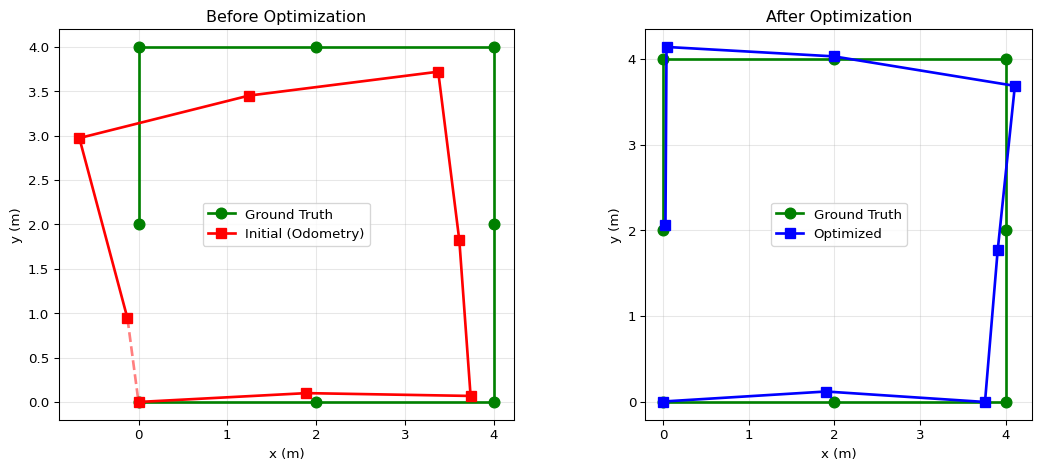
Example: Square Loop

Code
np.random.seed(123)

# True poses: square path
true_poses = [
    (0, 0, 0),
    (2, 0, 0),
    (4, 0, np.pi/2),
    (4, 2, np.pi/2),
    (4, 4, np.pi),
    (2, 4, np.pi),
    (0, 4, -np.pi/2),
    (0, 2, -np.pi/2),
]

# Generate noisy odometry measurements
edges = [(i, i+1) for i in range(7)]  # Sequential
edges.append((7, 0))  # Loop closure!

measurements = []
for i, j in edges:
    Ti = pose_to_matrix(*true_poses[i])
    Tj = pose_to_matrix(*true_poses[j])
    T_rel = np.linalg.inv(Ti) @ Tj
    z = matrix_to_pose(T_rel)
    # Add noise (more noise on odometry, less on loop closure)
    if j == i + 1:  # Odometry
        noise = np.array([0.1, 0.1, 0.05]) * np.random.randn(3)
    else:  # Loop closure (often more accurate)
        noise = np.array([0.05, 0.05, 0.02]) * np.random.randn(3)
    measurements.append(tuple(np.array(z) + noise))

# Initial poses from chaining odometry (with drift)
initial_poses = [np.array([0.0, 0.0, 0.0])]
T_acc = np.eye(3)
for i in range(7):
    T_rel = pose_to_matrix(*measurements[i])
    T_acc = T_acc @ T_rel
    initial_poses.append(np.array(matrix_to_pose(T_acc)))

# Optimize
optimized_poses = optimize_pose_graph(initial_poses, edges, measurements, n_iter=20)

# Plot comparison
fig, axes = plt.subplots(1, 2, figsize=(12, 5))

# Before optimization
ax = axes[0]
init_arr = np.array(initial_poses)
true_arr = np.array(true_poses)
ax.plot(true_arr[:, 0], true_arr[:, 1], 'g-o', markersize=8, linewidth=2, label='Ground Truth')
ax.plot(init_arr[:, 0], init_arr[:, 1], 'r-s', markersize=8, linewidth=2, label='Initial (Odometry)')
# Draw loop closure gap
ax.plot([init_arr[-1, 0], init_arr[0, 0]], [init_arr[-1, 1], init_arr[0, 1]],
        'r--', linewidth=2, alpha=0.5)
ax.set_xlabel('x (m)')
ax.set_ylabel('y (m)')
ax.set_aspect('equal')
ax.grid(True, alpha=0.3)
ax.legend()
ax.set_title('Before Optimization')

# After optimization
ax = axes[1]
opt_arr = np.array(optimized_poses)
ax.plot(true_arr[:, 0], true_arr[:, 1], 'g-o', markersize=8, linewidth=2, label='Ground Truth')
ax.plot(opt_arr[:, 0], opt_arr[:, 1], 'b-s', markersize=8, linewidth=2, label='Optimized')
ax.set_xlabel('x (m)')
ax.set_ylabel('y (m)')
ax.set_aspect('equal')
ax.grid(True, alpha=0.3)
ax.legend()
ax.set_title('After Optimization')

plt.tight_layout()
plt.show()

# Print errors
init_error = np.mean([np.linalg.norm(init_arr[i, :2] - true_arr[i, :2]) for i in range(8)])
opt_error = np.mean([np.linalg.norm(opt_arr[i, :2] - true_arr[i, :2]) for i in range(8)])
print(f"Mean position error - Initial: {init_error:.3f} m, Optimized: {opt_error:.3f} m")
Mean position error - Initial: 0.593 m, Optimized: 0.152 m
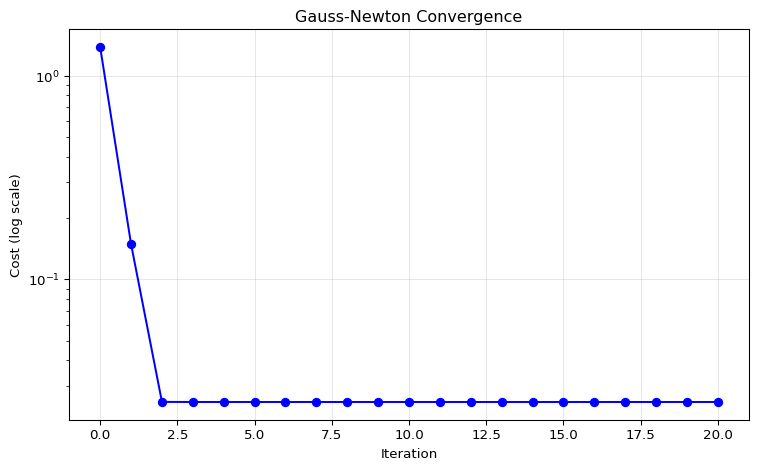
Convergence

Code
# Track cost over iterations
def compute_total_cost(poses, edges, measurements):
    cost = 0
    for (i, j), z_ij in zip(edges, measurements):
        e = compute_residual(poses[i], poses[j], z_ij)
        cost += e @ e
    return cost

# Re-run optimization tracking cost
poses = [np.array(p) for p in initial_poses]
costs = [compute_total_cost(poses, edges, measurements)]

for iteration in range(20):
    H, b = build_linear_system(poses, edges, measurements)
    H[0:3, 0:3] += 1e6 * np.eye(3)
    dx = np.linalg.solve(H, -b)
    for i in range(len(poses)):
        poses[i] = poses[i] + dx[3*i:3*i+3]
        poses[i][2] = np.arctan2(np.sin(poses[i][2]), np.cos(poses[i][2]))
    costs.append(compute_total_cost(poses, edges, measurements))

fig, ax = plt.subplots(figsize=(8, 5))
ax.semilogy(costs, 'b-o', markersize=6)
ax.set_xlabel('Iteration')
ax.set_ylabel('Cost (log scale)')
ax.set_title('Gauss-Newton Convergence')
ax.grid(True, alpha=0.3)
plt.tight_layout()
plt.show()
Note

Gauss-Newton converges quickly — typically 5-10 iterations suffice.

Part 5: Practical Considerations

Weighted Edges

Different measurements have different uncertainties.

Information matrix \(\Omega_{ij}\):

  • Diagonal: \(\Omega = \text{diag}(\sigma_x^{-2}, \sigma_y^{-2}, \sigma_\theta^{-2})\)
  • More confident measurements → larger \(\Omega\) → more influence

Cost function becomes: \[ F(x) = \sum_{(i,j) \in \mathcal{E}} e_{ij}^T \Omega_{ij} \, e_{ij} \]

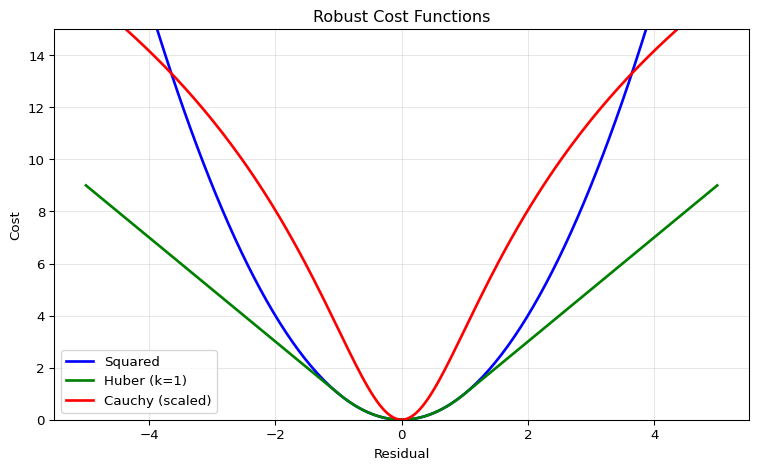
Robust Cost Functions

Loop closure detection can produce outliers (false matches).

Standard least squares is sensitive to outliers!

Solution: Use robust kernels

Kernel Formula Effect
Squared \(\rho(r) = r^2\) Standard (sensitive)
Huber \(\rho(r) = \begin{cases} r^2 & |r| \leq k \\ 2k|r| - k^2 & |r| > k \end{cases}\) Linear growth for outliers
Cauchy \(\rho(r) = \log(1 + r^2)\) Bounded influence

Robust Cost Visualization

Loop Closure Detection

We assumed loop closures are given. In practice, detecting them is challenging!

Approaches:

  1. Scan-to-scan matching: Match current scan against all previous scans

    • Expensive: \(O(n^2)\) comparisons
  2. Scan-to-map matching: Match against accumulated map

  3. Place recognition: Use descriptors to find candidate matches

    • Bag-of-words, learning-based methods

Libraries for Pose Graph Optimization

In practice, use optimized libraries:

GTSAM (Georgia Tech Smoothing and Mapping)

  • Factor graph formulation
  • Incremental updates (iSAM2)
  • Widely used in robotics research

g2o (General Graph Optimization)

  • C++ library
  • Used in ORB-SLAM, LSD-SLAM

Ceres Solver

  • Google’s nonlinear least squares library
  • Very flexible, automatic differentiation

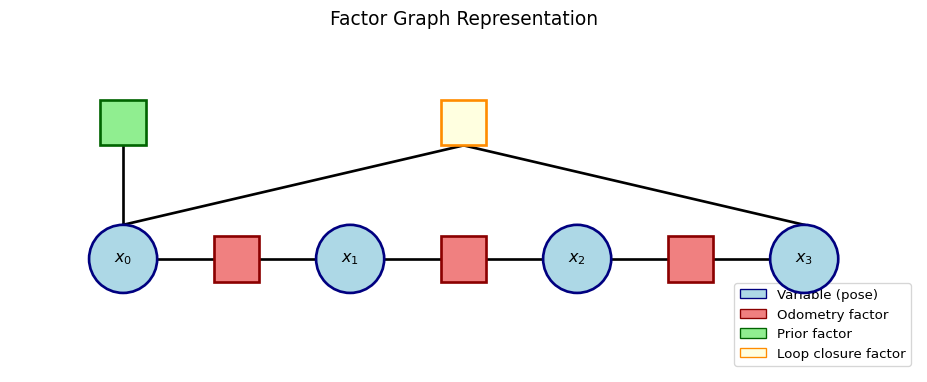
Factor Graph View

GTSAM uses “factor graph” terminology:
Note

Variables are poses, factors are constraints (measurements). Same math, different visualization!

Connection to Your Assignment

Your scan matching assignment involves:

  1. Sequential scan matching → odometry edges
  1. Long-range scan matching → loop closure edges
    • Match scan \(k\) against scans \(0, 1, \ldots, k-10\) (for example)
    • If match quality is good, add loop closure edge
  1. Pose graph optimization → correct drift
    • Build graph with all edges
    • Optimize to find best poses

Summary

  1. Problem: Odometry drift accumulates; loop closures provide constraints

  2. Graph structure: Nodes = poses, edges = relative pose measurements

  3. Formulation: Nonlinear least squares on SE(2) residuals

  4. Key insight: Jacobian/Hessian is sparse → tractable for large graphs

  5. Practice: Use robust kernels for outliers, libraries for efficiency

References

  • Grisetti, G., Kummerle, R., Stachniss, C., & Burgard, W. (2010). “A Tutorial on Graph-Based SLAM.” IEEE Intelligent Transportation Systems Magazine.

  • Dellaert, F., & Kaess, M. (2017). “Factor Graphs for Robot Perception.” Foundations and Trends in Robotics.

  • Carlone, L., et al. (2025). “Slam handbook: From localization and mapping to spatial intelligence.”.

  • GTSAM: https://gtsam.org

  • g2o: https://github.com/RainerKuemmerle/g2o